What Is the Best Primer and Paint for Old Houses
General Information
Painting Tips for Your Historic Edifice
Painting Tips for Your Celebrated Building | Wisconsin Historical Order
Whether y'all are painting the outside or the interior of your celebrated house or building, you lot want the finished job to await great — and to last a long fourth dimension. The communication offered beneath volition help you reach those goals.
Follow All-time Practices
Preservation best practices for painting require a thoughtful approach to maintaining or repainting originally painted surfaces. To retain the character of your celebrated structure, you must maintain the original shellac and varnish finishes or use a replacement cease that matches the original stop. Yous should never paint any previously unpainted surfaces in your celebrated house or building.
As a rule, you should never paint unpainted bricks, stones, stucco or concrete. If your brick construction has been painted for a long fourth dimension, the paint was probably applied to cover a problem with the bricks. The bricks may accept been soft and deteriorating, or they may have been sandblasted at a fourth dimension when this was pop. You should hire an experienced mason to determine whether the paint can or should be removed. If the bricks must be painted but need a fresh paint task, be certain to repaint them with a production that has high vapor permeability. These products are available through masonry supply companies.
Use the Right Products
You take many paint and primer options to choose from, and then do a picayune homework to brand certain you select the best paint for your house or building. Hither are some tips to help yous brand this determination:
- Use a liquid paint splatter removal product to make up one's mind if your existing pigment is latex or oil. The pigment splatter removal product will remove the paint if information technology is latex, but it will have no issue if it is oil paint.
- Never apply oil-based pigment on a surface painted with latex paint. This do volition create compatibility issues due to the different curing procedure of each type of paint. However, you lot Can apply exterior latex paint on a surface painted with exterior oil-based paint.
- Utilise an alkyd oil-based primer. These primers penetrate into former exterior wood better than latex paints, and you can use latex top coats on the alkyd oil-based primers. For fifty-fifty ameliorate penetration into former woods, add together 1/8 loving cup of boiled linseed oil to each gallon of alkyd oil-based primer.
Prepare the Surface Properly
You tin can take measures to prevent paint failure by properly preparing the surface to be painted. Here are a few surface preparation tips:
- Use a moisture meter to cheque the moisture content of whatsoever wood surface you lot programme to paint. Moisture wood will not hold pigment, then you should non pigment whatsoever wood with a moisture content greater than 15%. Yous can buy a moisture meter at a pigment store or lumberyard.
- Assume that the sometime paint in your historic house or building contains lead, and follow procedures for the safe treatment and removal of lead paint.
- Never dry scrape any one-time paint. Mist the wood with water kickoff to forestall the spread of atomic number 82 dust.
- Use a pigment removal device that is adaptable and verify that the operating temperature is kept well below 650 degrees Fahrenheit — the temperature at which pb paint becomes a toxic vapor. Infrared paint removal tools will not heat the pigment over 600 degrees and are approved by the Environmental Protection Bureau for prophylactic atomic number 82 pigment removal.
- Sand off the shiny gray layer on a forest surface before you lot paint it. This graying is deterioration is caused by exposure to sunlight.
- Make clean and lightly sand or de-gloss oil paint earlier you apply interior latex paint over whatsoever sleeky interior oil pigment.
- Practise non use hard fillers to fill exterior boom holes. Apply linseed oil-based glazing compound to let the wood to expand and contract.
- Always prime before y'all caulk. Dry wood absorbs the oils in caulk, causing the caulk to shrink and fail.
- Only add exterior caulk in locations where cascading water tin enter a joint.
- Apply exterior paint on window sashes and so information technology extends 1/16 inch onto the drinking glass to seal the glazing compound.
Utilize Constructive Painting Strategies and Techniques
Overstate 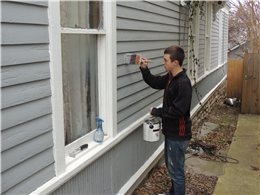
For best results, always paint in the shade. When paint dries likewise rapidly it can bubble leading to a poor end result. Source: Bob Yapp
To ensure your painting efforts volition be constructive, follow these strategies and techniques:
- Never pigment exterior when the temperature exceeds 90 degrees Fahrenheit or when the temperature will not reach 50 degrees for 24 hours.
- Never paint outside in direct sunlight. Directly sunlight creates excessive heat and tin can cure the paint too chop-chop, causing paint adhesion issues.
- Never pigment exterior when the humidity level is over lxxx%. High humidity creates excessive moisture on the surfaces being painted and can prevent the pigment from adhering properly.
- Never utilize oil pigment when the temperature exceeds 90 degrees or when the temperature will non reach xl degrees for 24 hours after painting.
- Never apply latex paint when the temperature exceeds 80 degrees or when the temperature will not reach 50 degrees for 24 hours later on painting.
- Never spray paint woods exteriors. Spray painting provides less surface adhesion and paint thickness than brush painting.
- Remove painter's tape as shortly as the paint is dry. Blue and dark-green painter's tape that remains on a painted or natural finish surface for over a week will damage the paint or stop.
Clean and Maintain Painted Surfaces
Your painting job is non washed every bit shortly every bit the pigment dries. Follow these practices to clean and maintain the painted surfaces in your house or building:
- Accept that there is no such affair as "maintenance complimentary" paint. You should do yearly maintenance on both interior and outside painted surfaces to forestall peeling paint and surface deterioration.
- Mitt scrub painted surfaces with trisodium phosphate (TSP) and water. TSP is available at all paint and hardware stores in a synthetic version that will not harm groundwater. Add together ane/8 cup of TSP pulverization to a five-gallon bucket of water. Rinse with clear water later on.
- Never pressure wash historic painted surfaces. Force per unit area washing does not scrape away quondam paint or make clean the painted surface.
- Ever shop extra paint in a dry, warm surface area for touch up and maintenance.
The data presented hither is non intended to provide comprehensive technical communication or instructions on solving celebrated preservation bug. Any data independent or referenced is meant to provide a basic understanding of celebrated preservation practices. Read full disclaimer.
Source: https://www.wisconsinhistory.org/Records/Article/CS4241
0 Response to "What Is the Best Primer and Paint for Old Houses"
Enregistrer un commentaire