what was the transgression against yah that balaam caused israel to do

Balaam (;[1] Hebrew: בִּלְעָם, Standard Bīlʻam Tiberian Bīlʻām) is a diviner in the Torah (Pentateuch) whose story begins in Affiliate 22 of the Volume of Numbers (Numbers 22). Every ancient reference to Balaam considers him a not-Israelite, a prophet, and the son of Beor. [ii] Rex Balak of Moab offered him money to curse State of israel (Numbers 22–24), but Balaam blest the Israelites instead equally dictated by God. Nevertheless, he is reviled as a "wicked man" in both the Torah and the New Testament (2 Peter two:15, Jude ane:eleven, Revelation 2:xiv). According to the Book of Revelation (Revelation ii:14), Balaam told King Balak how to get the Israelites to commit sin past enticing them with sexual immorality and nutrient sacrificed to idols. The Israelites brutal into transgression due to these traps and God sent a deadly plague to them as a outcome (Numbers 31:16).
Balaam and Balak [edit]
The main story of Balaam occurs during the sojourn of the Israelites in the plains of Moab, due east of the Jordan River, at the close of 40 years of wandering, shortly before the death of Moses and the crossing of the Jordan. The Israelites accept already defeated two kings in Transjordan: Sihon, male monarch of the Amorites, and Og, king of Bashan. Balak, king of Moab,[3] consequently becomes alarmed, and sends elders of Midian and his Moabite messengers,[4] to Balaam, son of Beor, to induce him to come and curse Israel. Balaam's location, Pethor, is simply given as "which is by the river of the land of the children of his people" in the Masoretic Text and the Septuagint, though the Samaritan Pentateuch, Vulgate, and Peshitta all identify his land as Ammon.
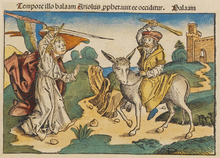

Balaam sends back word that he tin can simply practise what YHWH commands, and God has, via a nocturnal dream, told him non to go. Balak consequently sends higher-ranking priests and offers Balaam honours; Balaam continues to printing God, and God finally permits him to get but with instructions to say only what He commands. Balaam so sets out in the forenoon with the princes of Moab. God becomes angry that he went, implying that he simply used Balaam as a tool to further his will, and sends the Affections of the Lord (Numbers 22:22) to forestall him. At get-go, the angel is seen just past the ass Balaam is riding, which tries to avoid the angel. After Balaam starts punishing the donkey for refusing to move, it is miraculously given the ability to speak to Balaam (Numbers 22:28), and it complains about Balaam'southward treatment. At this point, Balaam is allowed to run across the angel, who informs him that the donkey'due south turning away from the messenger is the only reason the affections did not impale Balaam. Balaam immediately repents, simply is told to keep.
Balak meets with Balaam at Kirjat Huzoth, and they go to the "high places of Baal", and offer sacrifices on 7 altars, leading to Balaam existence given a prophecy by Yahweh, which He speaks to Balak. However, the prophecy blesses Israel; Balak remonstrates, simply Balaam reminds him that he can simply speak the words put in his mouth, so Balak takes him to another "loftier place" at Pisgah, to endeavour again. Edifice another 7 altars here, and making sacrifices on each, Balaam provides some other prophecy blessing Israel.
Balaam finally gets taken by a now very frustrated Balak to Peor, and, after the seven sacrifices at that place, decides non to "seek enchantments" but instead looks upon the Israelites from the meridian. The Spirit of God comes upon Balaam and he delivers a tertiary positive prophecy concerning Israel. Balak's anger rises to the point where he threatens Balaam, but Balaam merely offers a prediction of fate. Balaam then looks upon the Kenites, and Amalekites and offers ii more predictions of their fates. Balak and Balaam then get to their corresponding homes.
Later on, Numbers 25:1-9 describes how State of israel engaged in the Heresy of Peor. Numbers 31:16 blames this on Balaam's advice and because of his culpability in the incident, which resulted in mortiferous divine judgements confronting the Israelites who participated, he was eventually killed in a retaliatory boxing against Midian in Numbers 31:eight.
Deuteronomy 23:3–half-dozen summarises these incidents, and further states that the Ammonites were associated with the Moabites. Joshua, in his bye spoken communication, also makes reference to it. With God'due south protection taken from him, Balaam is later listed among the Midianites who were killed in revenge for the "matter of Peor". Joshua xiii:22 records that Balaam died "by the sword" during a battle for the Reubenite occupation of Moabite land.
Revelation besides states that Balaam "taught Balak to cast a stumbling block earlier the children of Israel."[five]
The story of Balaam and Balak is too fabricated reference to in affiliate x of 2 Meqabyan, a volume considered canonical in the Ethiopian Orthodox Tewahedo Church.[6]
Prophecies [edit]

All the prophecies which Balaam makes take the form of (Hebrew) poems:
- The first, Numbers 23:7–10, prophesies the unique exaltation of the Kingdom of State of israel, and its countless numbers.
- The 2d, Numbers 23:18–24, celebrates the moral virtue of Israel, its monarchy, and its war machine conquests.
- The third, Numbers 24:three–ix, celebrates the celebrity and conquests of Israel's monarchy. It is the source of the liturgical prayer Ma Tovu - "How proficient are your tents, O Jacob, your tabernacles, O Israel!"
- The fourth, Numbers 24:14–19, prophesies the coming of a king who volition conquer Edom and Moab.
- The fifth, Numbers 24:20, concerns the ruins of Amalek.
- The sixth, Numbers 24:21–22, concerns the destruction of the Kenites past Assyria.
- The 7th, Numbers 24:23–24, concerns "ships of Kittim" coming from the west to attack Assyria and Eber.
The poems fall into three groups. The kickoff group consists of two poems which characteristically start immediately. The tertiary group of three poems also start immediately, just are much shorter. The second group, however, consists of ii poems which both start:
Balaam the son of Beor hath said, and the man whose eyes are open hath said: He hath said, which heard the words of God, which saw the vision of the Almighty, falling into a trance, but having his eyes open ...
Of these, the first and third groups are considered, according to the Documentary Hypothesis, to originate within the Elohist text, whereas the 2d group is considered to vest to the Jahwist. Thus the Elohist describes Balaam giving 2 blessings, making sacrifices on vii altars, at the loftier places of Baal, before each, so deciding not to "seek enchantments" after the 3rd set of sacrifices, but to "set his face upon the wilderness," which Balak views as a third blessing, and so Balaam then gives the three final predictions of fate. Conversely, in the Jahwist source, Balaam arrives, the spirit of God comes upon him, and he simply delivers a blessing and a prophecy, in succession.
Agag, mentioned in the third poem, is described as a great king, which does non correspond to the king of the Amalekites who was named Agag, and described in I Samuel 15, since that description considers Amalek to be small and obscure. While information technology is the Masoretic text of the poem that uses the word Agag, the Septuagint, other Greek versions, and the Samaritan Pentateuch, all have Gog. These names are consequently thought to be textual corruptions, and Og has been suggested as the original.
The terminal three poems do not refer either to Israel or to Moab, and are thus considered unusual, since they seem to have niggling relevance to the narrative. It is idea that they may have been added to bring the number of poems either up to five, if inserted into the Elohist source, or up to seven, if simply inserted once JE was constructed. While the sixth poem refers to Assyria, it is uncertain whether it is an historical reference to ancient Ninevah, or a prophecy, which some religious commentators consider refers to the Seleucid kingdom of Syria, which besides took the proper noun Assyria. The 7th is also cryptic, and may either exist a reference to the Sea Peoples, or, again in the view of some religious commentators, to the conquest of Persia by Alexander the Great.
In the view of some schools of textual criticism[vii] the narrative, excepting the episode involving the ass, is simply a framework invented in order to exist able to insert much older poems.
Balaam in rabbinic literature [edit]
In rabbinic literature Balaam is represented as one of seven gentile prophets; the other six being Beor (Balaam'south male parent), Job, and Job'due south iv friends (Talmud, B. B. 15b). In this literature, Balaam gradually acquired a position among the non-Jews, which was exalted as much as that of Moses among the Jews (Midrash Numbers Rabbah 20); at first beingness a mere interpreter of dreams, but subsequently becoming a sorcerer, until finally the spirit of prophecy descended upon him (ib. vii).
According to a negative view of Balaam in the Talmud, Balaam possessed the gift of existence able to ascertain the exact moment during which God is wroth — a gift bestowed upon no other animal. Balaam'southward intention was to curse the Israelites at this moment of wrath, and thus cause God himself to destroy them; but God purposely restrained His acrimony in order to baffle the wicked prophet and to save the nation from extermination (Talmud, Berachot 7a). The Talmud also recounts a more positive view of Balaam, stating that when the Police force was given to Israel, a mighty vox shook the foundations of the earth, and then much so that all kings trembled, and in their consternation turned to Balaam, inquiring whether this upheaval of nature portended a second deluge; the prophet bodacious them that what they heard was the voice of God, giving the sacred constabulary to the Israelites (Talmud, Zeb. 116a).
According to Jewish fable, Balaam was made this powerful in order to prevent the non-Jewish tribes from saying: "If we had just had our own Moses, we would exist as pious as the Jews." The wicked Balaam is included in the listing of persons born circumcised along with Moses in the book Abbot De-Rabbi Natan.[eight]
In rabbinical literature the epithet rasha, translating as the wicked one, is ofttimes attached to the name of Balaam (Talmud Berachot l.c.; Taanit 20a; Midrash Numbers Rabbah 20:14). Balaam is pictured every bit blind in one eye and lame in ane foot (Talmud Sanhedrin 105a); and his disciples (followers) are distinguished by 3 morally corrupt qualities:
- an evil eye
- a haughty begetting
- an acquisitive spirit
Due to his beliefs with the Midianites, the Rabbis interpret Balaam as responsible for the behavior during the Heresy of Peor, which they consider to take been unchastity, and consequently the death of 24,000 victims of the plague which God sent as punishment. When Balaam saw that he could not curse the children of Israel, the Rabbis assert that he advised Balak, every bit a final resort, to tempt the Hebrew nation to immoral acts and, through these, to the worship of Baal-peor. The God of the Hebrews, adds Balaam, according to the Rabbis, hates lewdness; and astringent chastisement must follow (San. 106a; Yer. ib. x. 28d; Num. R. l.c.).
The Rabbis, playing on the proper noun Balaam, telephone call him "Belo 'Am" (without people; that is, without a share with the people in the world to come), or "Billa' 'Am" (one that ruined a people); and this hostility confronting his memory finds its climax in the dictum that whenever ane discovers a feature of wickedness or disgrace in his life, one should preach nigh it (Sanh. 106b). In the procedure of killing Balaam (Num. xxxi. 8), all 4 legal methods of execution—stoning, burning, decapitating, and strangling—were employed (Sanh. l.c.). He met his death at the historic period of thirty-three (ib.); and it is stated that he had no portion in the globe to come up (Sanh. x. ii; 90a). The book devotes a special section to the history of the prophet discussing why God has taken away the ability of prophecy from the Gentiles (Tan., Balak, 1). Moses is expressly mentioned as the writer of this episode in the Pentateuch (B. B. 14b).J. Sr. H. 1000.
"Ahithophel of the house of Israel and Balaam of the heathen nations were the ii great sages of the world who, declining to show gratitude to God for their wisdom, perished in dishonor. To them the prophetic word finds awarding: 'Let not the wise man glory in his wisdom,' Jer. ix. 23" (Num. R. xxii.).[9]
In (Sanhedrin 106b) and (Giṭtin 57a) Balaam may exist likened to Jesus. Some have theorized that Balaam became used every bit a pseudonym for Jesus in Jewish literature.[x] [11] [12] [13] Balaam's father Beor was a son of Laban.[14] The Book of Jasher reports Balaam's sons were Jannes and Jambres[15]
Balaam in the New Testament, Josephus, and Philo [edit]
In the New Testament, Balaam is cited as a blazon of avarice; for example in Book of Revelation 2:xiv we read of simulated teachers at Pergamum who held the "teaching of Balaam, who taught Balak to cast a stumbling-block earlier the children of State of israel, to eat things sacrificed to idols, and to commit fornication." Balaam has attracted much interest, alike from Jews, Christians, and Muslims. Josephus paraphrases the story more so, and speaks of Balaam as the best prophet of his time, just with a disposition ill-adapted to resist temptation.[xvi] Philo describes him as a great sorcerer in the Life of Moses;[17] elsewhere he speaks of "the sophist Balaam, being," i.e. symbolizing "a vain crowd of opposite and warring opinions" and once more as "a vain people" — both phrases being based on a mistaken etymology of the name Balaam.
A human being as well named Balaam also figures as an example of a simulated prophet motivated by greed or avarice in both two Peter 2:xv and in Jude 1:11. This Balaam is listed as the son of Bezer, which is unremarkably identified as Beor.[eighteen] [19] [20] [21] Some authors claim that Bezer was the Aramaic pronunciation of Beor,[20] while others hold that the writer was attempting to play off the Hebrew give-and-take basar or "flesh" to insult Balaam. After Jewish tradition similarly played with Balaam's name to call him corrupt and imply animality. Notwithstanding other authors concur that Bezer and Beor are distinct, while still identifying the Balaams of the Old and New Testaments, claiming that Beor is Balaam's father and Bezer is Balaam's dwelling house town.[21]
Balaam in the Quran [edit]
Regarding the Islamic view of Balaam, no clear reference is made to Balaam in the Qur'an. Nonetheless, the commentators argue that he is the one to whom the post-obit text is referring:
Relate to them the story of the human being to whom We sent Our signs, merely he passed them by: so Satan followed him up, and he went off-target.
If it had been Our volition, We should have elevated him with Our signs; merely he inclined to the earth, and followed his own vain desires. His similitude is that of a dog: if yous attack him, he lolls out his tongue, or if you leave him solitary, he (still) lolls out his natural language. That is the similitude of those who reject Our signs; So relate the story; perchance they may reflect.
The Muslim commentators explain that Balaam was a Canaanite who had been given cognition of some of the books of God. His people asked him to curse Moses (Musa) and those who were with him, but he said, "How tin can I curse one who has angels with him?" They connected to press him, however, until he cursed the Israelites, and, as a consequence, they remained xl years in the Wilderness of the Wanderings. So, when he had cursed Moses, his tongue came out and roughshod upon his chest, and he began to pant like a canis familiaris.
The story every bit told by Tabari[23] is somewhat more Biblical. Balaam had the knowledge of the Most Sacred Proper noun of God, and any he asked of God was granted to him. The story of Balaam and the ass, and so follows at length. When it came to the actual cursing, God "turned his tongue" so that the cursing barbarous upon his own people and the approval upon Israel. And then his tongue came out and hung down on his breast. Finally, he brash his people to adorn and beautify their women and to transport them out to ensnare the Israelites. The story of the plague at Baal-peor and of Cozbi and Zimri[24] follows.
According to another story which al-Tabari gives, Balaam was a renegade Israelite who knew the Well-nigh Sacred Name, and to gain the things of this world, went over to the Canaanites. Al-Tha'labi[25] adds that Balaam was descended from Lot. He gives, besides, the story of Balaam's dream, his being forbidden past God to curse State of israel. Another version is that Balak, the male monarch of Bal'a, compelled Balaam to use the Virtually Sacred Proper noun against Israel. The curse fell automatically, and Moses, having learned from whence it came, entreated God to take from Balaam his knowledge of the Proper name and his faith. This beingness washed, they went out from him in the grade of a white pigeon.
The Baghdadi historian Al Masudi said in his volume Meadows of Gilded and Mines of Gems that Balaam ben Beor was in a village in the lands of Shem (Canaan), and he is the son of Baura(Beor) ben Sanur ben Waseem ben Moab ben Lot ben Haran (PUT), and his prayers were answered, so his folks asked him to pray against Joshua ben Nun but he could non exercise information technology, so he advised some of the kings of the giants to evidence the pretty women and release them toward the military camp of Joshua ben Nun, and so they did, and they (the Israelites) hurried up to the women and the plague spread amongst them and seventy thousand of them were dead.[26]
Balaam and the Deir Alla inscription [edit]
In 1967, at Deir Alla, Hashemite kingdom of jordan, archaeologists found an inscription with a story relating visions of the seer of the gods Bala'am, son of Be'or, who may be the same Bala'am mentioned in Numbers 22–24 and in other passages of the Bible. Bala'am is not specifically mentioned every bit a prophet of Yahweh in the Bible, but is called upon past Balak, a Moabite ruler, to curse the Israelites (Numbers Affiliate 22). Although Bala'am manifestly heard from Yahweh in the Biblical business relationship, Bala'am is associated with Ashtar, a god named Shgr, and Shadday gods and goddesses. Bala'am is blamed for educational activity Balak how to remove Yahweh'due south roofing from the Israelites through forbidden sexual relationships (Revelation two:xiv).[27]
The Oxford Handbook of Biblical Studies describes it as "the oldest case of a volume in a W Semitic language written with the alphabet, and the oldest slice of Aramaic literature."[28] The inscription is datable to ca. 840–760 BCE; it was painted in red and black inks, manifestly to emphasize the text, on fragments of a plastered wall: 119 pieces of inked plaster were recovered. According to the story in the inscription,[29] Balaam wakes up weeping and tells his people that the gods appeared to him in the night telling him about a goddess threatening to destroy the land. She is to comprehend the sky and reduce the world to consummate darkness. Meindert Dijkstra suggests that "the reticence of OT scholarship to take account of the text may be attributable to its damaged state, the difficulty of reconstructing and reading it, and the many questions it raises of script, linguistic communication, literary form and religious content."[30]
Meet likewise [edit]
- Balak (parsha)
- Biblical archaeology
Notes [edit]
- ^ Mangold, Max; Cho, Come across-Immature. "A Pronouncing and Phonetic Lexicon of Biblical Names". University of Tübingen. Archived from the original on 27 January 2013. Retrieved 24 October 2012.
- ^ "2 Peter 2:fifteen They accept left the directly mode and wandered off to follow the style of Balaam son of Beor, who loved the wages of wickedness". biblehub.com . Retrieved 2018-eleven-thirty .
- ^ Numbers 22:2
- ^ Numbers 22:iv–five
- ^ Revelation ii:14
- ^ "Torah of Yeshuah: Book of Meqabyan I - Iii".
- ^ Come across Critical View Nearly all modern expositors concur that the section xxii.–xxiv. belongs to the blended document JE "Balaam". Jewishencyclopedia.com.
- ^ The Fathers According to Rabbi Nathan. Translated from the Hebrew by Judah Goldin, Yale Judaica Serial 10, Affiliate two, p 23.
- ^ Jewish Encyclopedia http://jewishencyclopedia.com/view.jsp?artid=993&letter=A&search=Ahitophel. Retrieved 2012-07-30 .
- ^ "Bilam & Jesus". Oztorah.com. Retrieved 2012-07-30 .
- ^ Bileam and Jesus, in "Wissenschaftliche Zeitschrift für Jüdische Theologie," Volume 6, pp. 31–37
- ^ Jewish Encyclopedia, under the category of: Balaam
- ^ Schäfer, Peter. Jesus in the Talmud. Princeton University Printing (2007), Pages: 86-174
- ^ Jewish encyclopedia Laban
- ^ Jasher
- ^ Josephus, Antiquities of the Jews, 4. 6, § 2
- ^ Philo, De Vita Moysis, i. 48: "a man renowned above all men for his skill as a diviner and a prophet, who foretold to the diverse nations of import events, abundance and pelting, or droughts and famine, inundations or pestilence."
- ^ Who's Who of the Bible: Everything you lot need to know about everyone named in the Bible past Martin H. Manser and Debra Reid, Lion Books, 3 January 2013, p.53
- ^ The Proper Names of the Bible; Their Orthography, Pronunciation, and Signification, Etc by John Farrar, John Mason, 1839, p.58
- ^ a b A Dictionary of the Bible, Comprising Its Antiquities, Biography, Geography, and Natural History by William George Smith, Due south.S. Scranton & Company, 1896, p.123
- ^ a b Jude and two Peter (Baker Exegetical Commentary on the New Testament) by Gene Green, Bakery Academic, 1 Nov 2008, p.289
- ^ Quran 7:175–176
- ^ "Annales," ed. De Goeje, i. 508 et seq.
- ^ Num. xxv. 14, 15.
- ^ 'i'a' al-Anbiyya, pp. 206 et seq., Cairo ed., 1298.
- ^ cite web| url=https://www.sacred-texts.com/isl/pro/grp00.htm
- ^ Thomas L. Thompson (2000). "Problems of Genre and Historicity with Palestine's Descriptions". In André Lemaire, Magne Saebo (ed.). Supplements to Vetus Testamentum, Book 80. Brill. p. 322. ISBN978-9004115989.
- ^ Allan Millard (2006). "Authors, Books and Readers in the Ancient Earth". In J. Due west. Rogerson, Judith M. Lieu (ed.). The Oxford Handbook of Biblical Studies. Oxford University Printing. p. 554. ISBN978-0199254255.
- ^ J. Hoftijzer and 1000. van der Kooij, Aramaic Texts from Deir 'Alla Documenta et Monumenta Orientis Antiqui xix (Leiden) 1976.
- ^ Meindert Dijkstra, "Is Balaam As well among the Prophets?" Periodical of Biblical Literature 114.1 (Spring 1995, pp. 43–64), p. 44.
References [edit]
- Ausloos, Hans, On an Obedient Prophet and a Fickle God. The Narrative of Balaam in Numbers 22–24, in Old Testament Essays xx (2007) 84-104
- Hoftijzer, Jacob. "The Prophet Balaam in a 6th Century Aramaic Inscription." Biblical Archeologist 39.1 (March 1976), pp. eleven–17 (electronic edition 2001).
- McCarter, P. Kyle. "The Balaam Texts from Deir Allā: The First Combination." Bulletin of the American Schools of Oriental Research, no. 239 (Summertime 1980), pp. 49–60.
- Savelle, Charles. 2009. Canonical and Extracanonical portraits of Balaam. Bibliotheca Sacra 166:387-404.
- Shenk, Robert. "The Coherence of the Biblical Story of Balaam." Literature and Conventionalities 13 (1993), 31–51.
- Van Kooten, George H. and Jacques van Ruiten (edd.). Prestige of the Infidel Prophet Balaam in Judaism, Early on Christianity and Islam. Leiden: Brill, 2008.
Attribution
-
 This article incorporates text from a publication now in the public domain:Singer, Isidore; et al., eds. (1901–1906). "Balaam". The Jewish Encyclopedia. New York: Funk & Wagnalls.
External links [edit]
 | Wikimedia Commons has media related to Balaam. |
 | Wikiquote has quotations related to: Balaam |
- Bibliography on Balaam
- Biblical Hebrew Poetry – Reconstructing the Original Oral, Aural and Visual Experience
- The Oracles of Balaam (poetic portions of Numbers 23:7–24:24) Reconstructed
Source: https://en.wikipedia.org/wiki/Balaam
0 Response to "what was the transgression against yah that balaam caused israel to do"
Enregistrer un commentaire